
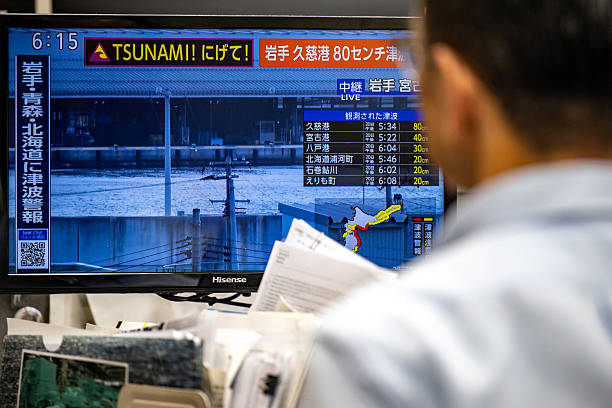
The Japan earthquake shakes the northeastern coast with a catastrophic 7.5-magnitude earthquake on Monday, April 20, 2026, and ripples of panic across coastal communities in the north of Japan. This was a strong quake that happened at 4:52 p.m. local time with its epicentre in the Pacific Ocean and a shallow depth of only 10 kilometres which sent out immediate tsunami warnings in Iwate, Aomori and Hokkaido.
Waves as high as 3 metres were predicted by the authorities, which led to the mass evacuation of thousands of homes. Prime Minister Sanae Takaki quickly put an emergency task force into action and she urged every citizen residing in the vulnerable coastal areas to evacuate immediately.
What Happened During the Japan Earthquake?
The Japan earthquake struck at 4:52 p.m. local time (0752 GMT), with its epicentre located in the Pacific Ocean at a shallow depth of just 10 kilometres. The Japan Meteorological Agency (JMA) recorded the tremor at an “upper 5” on Japan’s seismic intensity scale – powerful enough to make movement difficult for people and cause unreinforced concrete-block walls to collapse.
Tsunami warnings were immediately issued across a wide stretch of northern Japan. Authorities warned that waves as high as 3 metres (9.84 feet) could strike the coastlines of Iwate and Aomori prefectures on the main Honshu island, as well as the northern island of Hokkaido. Within the first hour after the quake, tsunami waves reaching up to 80 cm had already been detected along the shore.
Evacuations, Emergency Response, and Disruptions
Several port towns bore the immediate brunt of the disaster. Otsuchi and Kamaishi – two communities tragically familiar with destruction, having suffered devastating losses in the catastrophic 2011 earthquake and tsunami – once again issued evacuation orders for thousands of residents.
Prime Minister Sanae Takaichi swiftly activated an emergency task force and addressed the nation, urging citizens in affected areas to move to safety immediately. “Possible damage and casualties are now being looked into,” Takaichi told reporters from her offices in Tokyo.
Ships were seen sailing out of Hachinohe port in Hokkaido as a precautionary measure against incoming waves, with NHK broadcasting live footage as a “Tsunami! Evacuate!” alert flashed across screens nationwide. Bullet train services in the Aomori region were also halted due to the intensity of the tremors, according to Kyodo News Agency.
JMA officials further warned the public that significant aftershocks could continue in the days and weeks ahead, urging residents not to return to vulnerable coastal zones prematurely.
Nuclear Plants and Infrastructure: No Abnormalities Reported
Among the first issues that run high after every Japan earthquake of this magnitude is the security of nuclear plants. Authorities confirmed that no nuclear power plants are currently in active operation in the affected regions. There were no abnormalities reported in the idled facilities at Hokkaido Electric Power Co. and Tohoku Electric Power Co. which relieved a populace already on the alert.
The geographical location of Japan puts it directly in the “Ring of Fire” – a thin strip of volcanoes and oceanic trenches encircling the Pacific Basin. The nation witnesses no less than five earthquakes every five-minute long and takes up about 20 percent of all earthquakes in the world that have magnitudes of 6.0 or above. The most recent incident that gives the clearest recollection of the devastating power of nature was the 2011 calamity that led to nuclear meltdowns in the plant Fukushima.
FAQs About the Japan Earthquake
Q1: How strong was the Japan earthquake on April 20, 2026?
Japan earthquake was of magnitude 7.5 and it occurred at 10 km deep in the Pacific Ocean along the northeast coast.
Q2: Were there any casualties reported?
As of initial reports, Prime Minister Takaichi confirmed that possible damage and casualties were being investigated. No confirmed death toll had been issued at the time of publication.
Q3: Is there a risk of another Japan earthquake soon?
Yes. JMA officials warned that significant aftershocks are likely in the coming days and weeks following a tremor of this magnitude.
Q4: Were nuclear plants affected by the Japan earthquake?
No. Authorities confirmed no abnormalities at any idled nuclear facilities in the affected regions of Hokkaido and northeastern Honshu.
Get the Latest Updates at inkrisp.com. Also, follow our social media for updates on X and Instagram.