
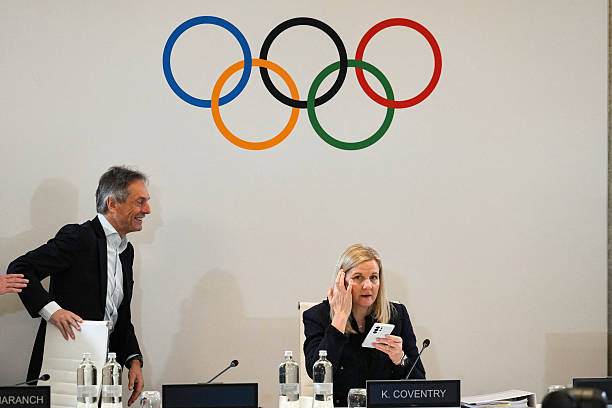
New IOC policy represents a historic change in Olympic eligibility, officially prohibiting transgender women from participating in women-only events since the 2028 Los Angeles Games. On March 26, 2026, the International Olympic Committee made the historic announcement, and instead of years of irregular, sport-by-sport eligibility rules, finally established a unified, genetics-based testing standard. The decision is in line with U.S. federal law and removes a prolonged debate on the inclusion of transgender in elite women’s sports. This is all you should know about what the policy says, why it was introduced, and what it means to the Olympics in the future.
What Is the New IOC Policy on Transgender Athletes?
The new IOC policy establishes that eligibility for women’s competition will be determined through a mandatory one-time genetics test. Athletes will be screened for the presence of the SRY gene – a genetic marker found on the Y chromosome that the IOC argues confers physical advantages that persist even after testosterone-reduction treatment.
The test may be carried out based on a sample of saliva or a cheek swab or a blood sample, which is a comparatively easy procedure in terms of logistics. Nevertheless, the consequences are far-reaching: any athlete who is tested as positive on the SRY gene will be considered ineligible to participate in women’s events in the Olympics.
This replaces the previous system where individual sports federations had the power to create their own policies governing transgender inclusion – a system that had produced mixed and often divisive outcomes in a number of different sports.
Why Did the IOC Make This Change?
The IOC used scientific rationale on the retained physical advantages as the basis of the policy. The point is that transgender women, or people born as men, but becoming females, keep some physiological properties associated with male puberty bone density, muscles, cardiovascular capacity, etc. in spite of the hormone treatment.
The decision also comes in alignment with the U.S. President Donald Trump’s executive order banning transgender athletes from participating in women’s sports at the federal level. With the 2028 Olympics scheduled to take place in Los Angeles, the new IOC policy effectively harmonizes international Olympic rules with current U.S. law.
It is worth noting that no transgender woman competed at the 2024 Paris Summer Olympics. The last transgender woman to compete at the Games was New Zealand weightlifter Laurel Hubbard, who participated in the 2021 Tokyo Olympics without winning a medal.
How Does This Policy Affect the 2028 Los Angeles Olympics?
The 2028 LA Games will be the first Olympics to be run under this single eligibility standard. The same genetics testing will be applied to all sports, eliminating the patchwork of federation-level regulations that had previously been used to regulate the matter.
Although it is not clear that any transgender women are currently competing at an Olympic qualifying level, the policy is a clear indication of where the IOC is headed toward Los Angeles and beyond. Those favoring transgender inclusion have labeled the move as discriminatory, and those in support claim there is a need to maintain competitive integrity in sport among women.
FAQs About the New IOC Policy
Q: When does the new IOC policy take effect?
The policy will come into effect in the 2028 Los Angeles Olympics, and it will be the first Olympics to introduce genetics-based eligibility testing on women’s events.
Q: What gene is being tested under the new IOC policy?
Athletes will be tested for the SRY gene, which the IOC argues is linked to physical advantages that are not fully eliminated through testosterone-reduction treatment.
Q: Has any transgender woman ever won an Olympic medal?
No. The only transgender woman to compete at the Olympics was weightlifter Laurel Hubbard of New Zealand at the 2021 Tokyo Games, where she did not win a medal.
Q: Does the new IOC policy apply to all sports?
Yes. In comparison with the past framework, the new policy is applicable to all the Olympic sports rather than individual sports, as it intends to do away with the sport-by-sport eligibility rules.
Get the Latest Updates at inkrisp.com. Also, follow our social media for updates on X and Instagram.