
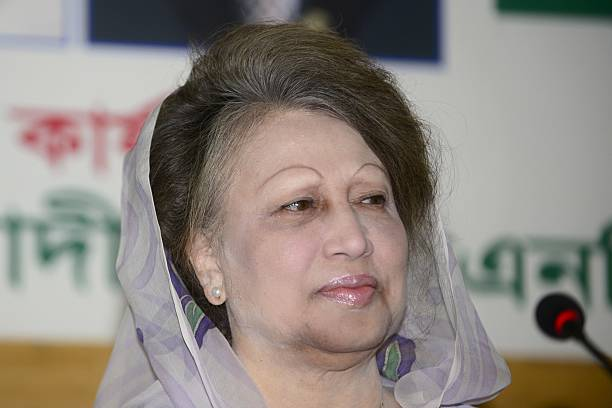
Begum Khaleda Zia, former Bangladesh Prime Minister and Bangladesh Nationalist Party (BNP) chief, passed away early Tuesday morning after a prolonged illness. She was 80. The three-time prime minister died at 6 am at Evercare Hospital in Dhaka, where she had been undergoing treatment for over a month, her party confirmed.
“The BNP Chairperson and former prime minister, the national leader Begum Khaleda Zia, passed away today at 6:00 am, just after the Fajr prayer,” the BNP said in a statement, adding that the party prayed for her soul and urged people to offer prayers.
Khaleda Zia had been admitted to the hospital on November 23 and was under treatment for the past 36 days. According to reports, she was suffering from infections in her heart and lungs, along with pneumonia. Her treatment was supervised by medical experts from Bangladesh, the UK, the US, China, and Australia. An attempt to take her abroad for advanced treatment earlier this month could not be carried out due to her fragile condition.
She is survived by her elder son, Tarique Rahman; his wife, Zubaida Rahman, and their daughter, Zaima Rahman. Tarique Rahman returned to Bangladesh on December 25 after spending 17 years in exile. Her younger son, Arafat Rahman Koko, had died earlier in Malaysia.
Khaleda Zia’s Political Career
Khaleda Zia was the first woman to become the prime minister of Bangladesh and one of the country’s most influential political figures. She formally entered politics after winning the 1991 national election through popular vote. As prime minister, she played a key role in restoring the parliamentary form of government, replacing the presidential system so that power rested with the prime minister. She also introduced the caretaker government system to ensure free and fair elections, lifted restrictions on foreign investment, and made primary education compulsory and free.
Born in 1945 in Jalpaiguri in British India, now in West Bengal, Khaleda Zia moved with her family to Dinajpur in East Bengal after Partition in 1947. Her father, Iskandar Mazumder, was a businessman, and her mother, Tayeba Mazumder, was a homemaker. Known by the nickname “Putul,” she studied at Dinajpur Missionary School and later completed her matriculation from Dinajpur Girls’ School in 1960.
She married Ziaur Rahman, then a captain in the Pakistan Army, in 1960 and continued her education until 1965. During the 1971 Liberation War, Ziaur Rahman revolted against Pakistan and fought for Bangladesh’s independence. He was assassinated on May 30, 1981.
After her husband’s death, Khaleda Zia entered politics to keep the BNP, founded by Ziaur Rahman, united during a period of crisis. She became the party’s vice-president in January 1984 and was elected chairperson in May the same year.
She later joined hands with Sheikh Hasina to lead a mass movement that overthrew military ruler Hossain Mohammad Ershad in 1990. However, their alliance soon turned into a fierce rivalry, earning them the nickname “the battling Begums.”
In the 1991 elections, BNP emerged as the single largest party, and Khaleda Zia was sworn in as Bangladesh’s first female prime minister. She served again briefly in 1996 and returned to power for a third term in October 2001 after a landslide victory.
Her second full term was marked by allegations of corruption and the rise of Islamist militancy. In 2004, a grenade attack on a rally addressed by Sheikh Hasina killed over 20 people and injured hundreds. Although Hasina survived, Zia’s government faced widespread blame. In 2018, Tarique Rahman was sentenced to life in prison in the case, a verdict BNP rejected as politically motivated.
Zia’s government ended in 2006 amid political unrest, after which an army-backed interim government took charge. Both Khaleda Zia and Sheikh Hasina were jailed for about a year on corruption charges before being released ahead of the 2008 elections.
She never returned to power. With BNP boycotting the 2014 and 2024 elections, her bitter feud with Hasina continued to shape Bangladesh’s politics for years, often leading to strikes, violence, and instability.
In 2018, Zia and her son were convicted in a corruption case involving foreign donations to an orphanage trust. She was jailed and later moved to house arrest in March 2020 due to worsening health. She was released from house arrest in August 2024 after Sheikh Hasina’s ouster.
In early 2025, Bangladesh’s Supreme Court acquitted Khaleda Zia and Tarique Rahman in the corruption case that led to their jail sentences. A month earlier, Rahman had also been acquitted in the 2004 grenade attack case.
Get the Latest Updates at inkrisp.com. Also, follow our social media for updates on X and Instagram.